
Infographic 01
Buyer problem map
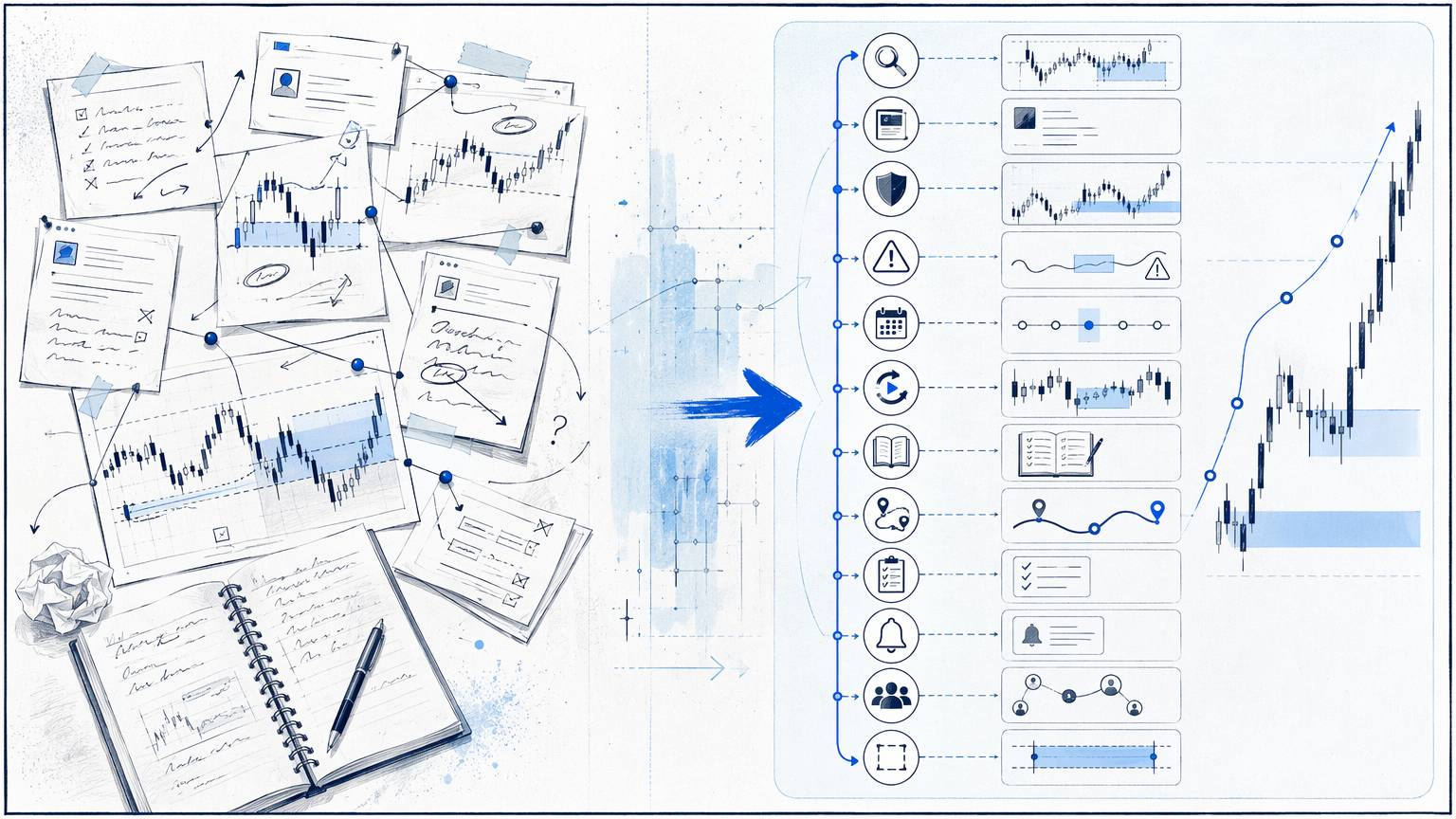
The old state is scattered: open tabs, half-learned SMC terms, alerts without context, and a journal that never turns into a repeatable process.
Trading education / alerts / community
Traders Blueprint gives retail traders a Shinobi Signals learning loop: live sessions, real-time alerts, IFVG and Order Block education, and community feedback around the same SMC framework.
Trading involves substantial risk. You are evaluating education, alerts, and community access, not guaranteed returns.
Generated visual proof
The lander now uses the same image-gen-2 visual system as the articles: white/light-blue editorial infographics, clear icon logic, no fake P&L, no invented dashboards, and no performance claims.
Infographic 01
The old state is scattered: open tabs, half-learned SMC terms, alerts without context, and a journal that never turns into a repeatable process.

Infographic 02
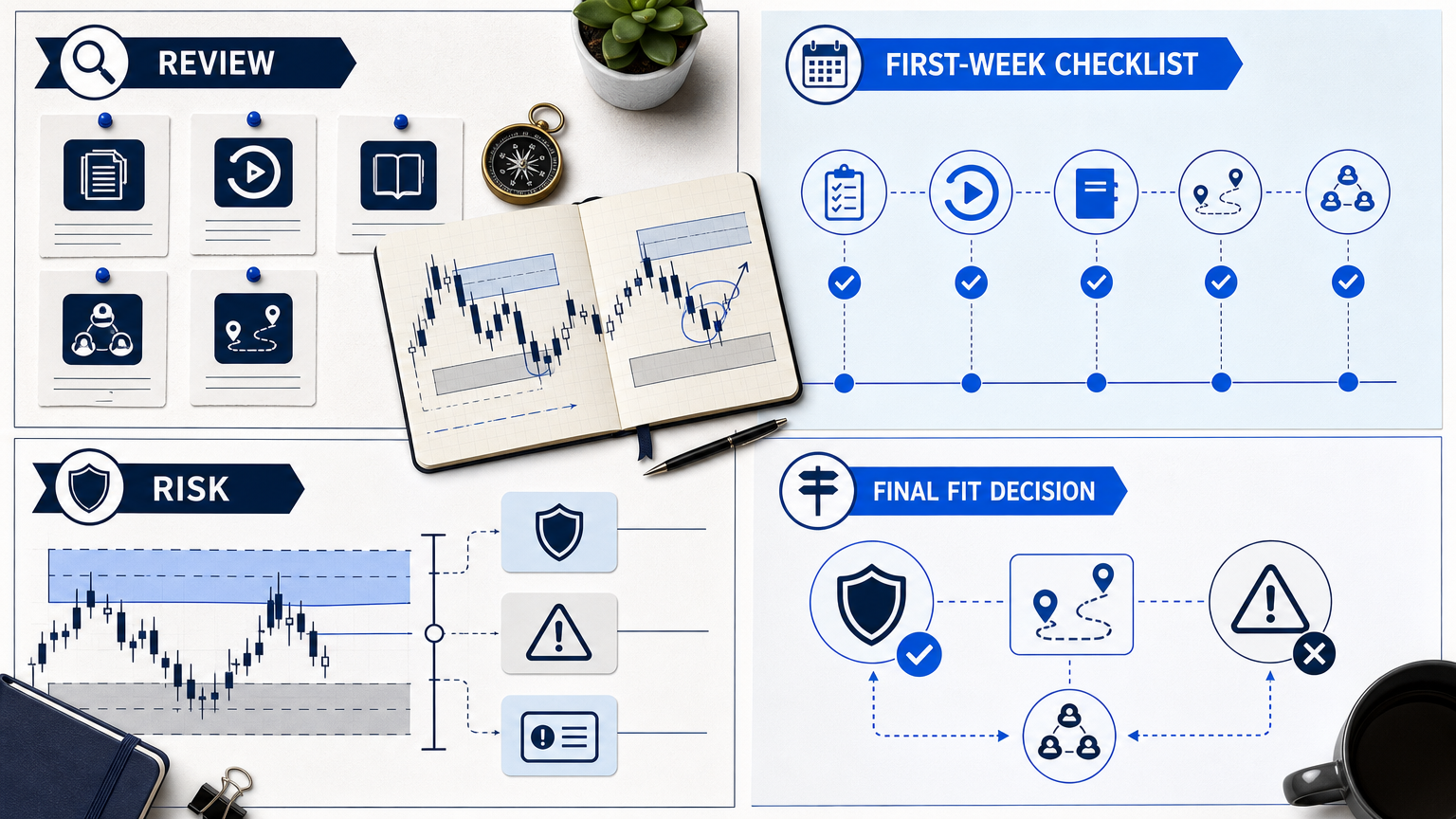
The weekly plan becomes a due-diligence sprint: watch one session, inspect one replay, trace one alert, write one glossary, and decide with evidence.
Infographic 03
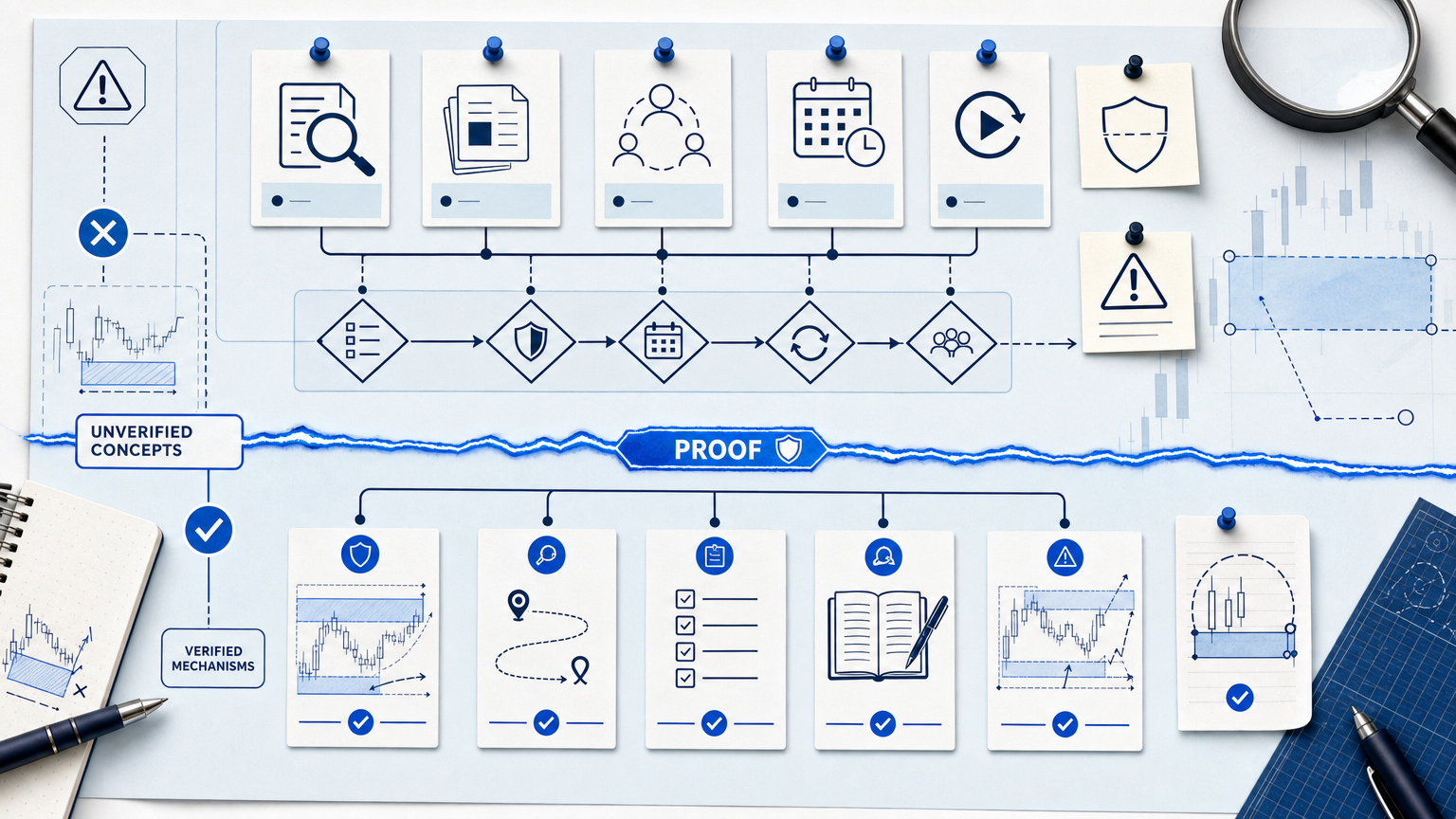
Keep the risk line visible before you join: education can improve preparation and review, but it cannot promise returns or remove uncertainty.
Infographic 04
A useful room gives you sharper language and cleaner questions. It should not become a steering wheel for decisions that still belong to you.
How to use it
The offer makes most sense as a review system: prepare, observe, compare, journal. Use that framing to avoid profit hype and stay focused on process.
Start with bias, liquidity, invalidation, and the zones Shinobi is watching before reacting to alerts.
Use IFVG and Order Block commentary as a structured learning prompt, not as a blind copy signal.
Turn live sessions, alerts, and chat feedback into notes you can compare across similar market days.
Inside the product
Live context, education, alerts, and a shared vocabulary for reviewing SMC setups.
Watch market context, planned zones, alerts, and decision review as the session develops.
Learn the vocabulary and repeatable price-action model behind the setups being discussed.
Use real-time alerts alongside member discussion so the trade idea has context and critique.
Use recorded lessons and market breakdowns to catch up when the live pace moves quickly.
Decision loop
You are not buying certainty. You are buying a tighter loop between market preparation, live commentary, alerts, and review. That is the honest value.
Start with what the room is watching: bias, liquidity, likely reaction zones, invalidation, and the session context. The first win is not a trade. It is knowing what would make a trade worth discussing.
Translate the stream into a plan. Which IFVG matters? Which Order Block matters? What would confirm the idea? What would cancel it? This is where scattered market noise becomes a checklist.
If you trade, the alert should sit inside the plan you already understand. If you do not trade, the live setup still becomes a worked example you can review without risking capital.
After the move, compare the original thesis to what happened. The journal matters because a trading room only compounds when the same language is used before, during, and after the session.
Infographic / offer math
The offer works only if it makes your first useful win faster: clearer session prep, cleaner alert context, and less wasted effort bouncing between disconnected trading content.
A calmer trading week because you know what the room is watching and why a setup is valid or invalid.
Raised by public proof points, a shared framework, live context, replays, and a weekly test path before monthly commitment.
Reduced by joining a live room where the first useful result can be a clearer watchlist, not a completed profitable trade.
Reduced when the education, alerts, community, and review loop all use the same language.
Decision CTA
Use the lower weekly entry when you want a short inspection window before making the monthly decision.
Decision CTA
Use the monthly listing only after the room, replays, alerts, and community match the job you defined.
Belief breakers
False belief
You probably need fewer unexamined signals and more context around the ones you do consider.
Traders Blueprint is strongest when treated as a live classroom: session commentary, alerts, replays, and community feedback all point at the same review loop.
False belief
A serious strategy gives you rules for acting under uncertainty. It does not remove the uncertainty.
That is why you should keep the risk boundary visible. SMC language can make planning clearer, but it cannot make markets predictable.
False belief
The weekly plan exists because you should test fit before committing to a longer subscription.
The local research inventory supports a $24.75 weekly entry product and a $78.75 monthly Shinobi Signals listing.
Risk map
Draw this line before you pay. A serious trading education offer should make good use cases obvious and bad use cases uncomfortable.
Watch sessions, study terminology, compare alerts to commentary, and build a repeatable journal.
If you choose to practice, keep it small enough that one bad read does not teach the wrong lesson.
Joining because you need fast money, revenge trades, or guaranteed returns is the wrong use case.
This is not positioned as a hands-off money button. Treat it as a trading classroom with live examples.
You want a structured SMC trading environment instead of disconnected videos.
You can review sessions, replays, and alerts consistently enough to learn the process.
You understand trading risk and want education plus community, not guaranteed outcomes.
First week plan
Start weekly, inspect the workflow, and decide with evidence. That is the smallest useful step before a monthly commitment.
Day 1
Join the weekly access, open the live and replay areas, and write down the exact vocabulary you keep seeing: IFVG, Order Block, liquidity, invalidation, session bias. Your only job is orientation.
Day 2
Pause after each key callout and ask what changed. Was the comment about price, time, liquidity, reaction, or risk? The more precisely you label the moment, the faster the material becomes usable.
Day 3
When an alert appears, do not treat it as a magic instruction. Place it beside the live commentary. What setup does it belong to? Which condition would make it invalid?
Day 4
Write plain-English definitions for the terms that keep repeating. If a term still sounds impressive but vague, it is not yours yet. Keep working until you can explain it without borrowing the group language.
Day 5
A room that only teaches the clean wins trains fantasy. Look for how misses, invalidations, or no-trade moments are handled. The after-action review is often where the useful education lives.
Day 6
Before the week renews, decide whether the workflow made your preparation clearer. If it did, monthly access may make sense. If it did not, the weekly test did its job.
Evidence ledger
Whop listing
Traders Blueprint by Shinobi Signals is positioned as trading education, alerts, live sessions, and community access.
Use
Whop listing
Research notes support 4.7 rating, 146 public ratings, and 917 product members at the time of the evidence pass.
Use with timestamp
Local notes
Weekly access was observed at $24.75 and monthly Shinobi Signals access at $78.75.
Use with checkout caveat
Compliance rule
Refund terms, affiliate terms, creator credentials, and performance outcomes need rechecking before paid traffic.
Do not imply
You are probably not short on market content. You have chart screenshots saved to your phone, Discord alerts from old groups, YouTube lessons you half-finished, and a list of SMC terms that sound important but never turn into a repeatable process. That is the real pain: fragmentation. One trader talks about liquidity, another talks about fair value gaps, another talks about psychology, and another shouts an entry after the move already happened. By Friday, you consumed hours of information and still cannot answer the basic question: what exactly am I supposed to look for before the bell, during the move, and after the session ends?
Do not buy Traders Blueprint so someone else can think for you. Buy it only if it compresses the distance between plan, live example, and review. Before the session, you need a map. During the session, you need commentary that explains what the map is doing in real time. After the session, you need a way to compare the original thesis to the outcome without rewriting history. That is the loop: plan, observe, compare, journal. If the community does not improve that loop for you, it is just entertainment with a checkout button.
Signals are easy to overvalue because they feel immediate. A notification appears, a level is named, and your brain mistakes speed for certainty. The useful question is not "did an alert appear?" The useful question is "do I understand the conditions around this alert well enough to decide what to do with it?" If you cannot explain the setup, invalidation, and review criteria, you are not really using a signal. You are outsourcing anxiety. Traders Blueprint becomes more valuable when you treat each alert as one artifact inside a larger lesson: what was watched, why it mattered, how the setup was managed, and what the replay teaches after the pressure is gone.
The weekly price is not just a smaller number. It changes your decision. A monthly plan asks, "Do I believe enough to commit?" A weekly plan asks, "Can I inspect the workflow before I commit?" That is the better first question. Use one week to test whether the group language makes charts clearer, whether the sessions fit your schedule, whether the replays are usable, and whether the community adds signal instead of noise. If the answer is yes, monthly access has a reason. If the answer is no, the weekly test saved you from forcing a bad fit.
Do not trust wild performance claims unless they are documented, current, and legally cleared. You do not need hype to evaluate this offer. The stronger proof is quieter: a live Whop listing, public rating data, visible product members, current pricing, and a clear explanation of what you are actually evaluating. That proof does not promise you an outcome. It tells you where the facts came from and which gaps remain. If you have already seen too many loud promises, that restraint should matter.
If you need guaranteed income, rent money, revenge after a loss, or a personality to follow blindly, this is the wrong purchase. If you want a structured place to watch SMC concepts applied live, compare alerts to commentary, build a glossary, and review your own decision-making, the offer becomes easier to understand. Join for structure. Do not join for rescue.
You start with too many inputs. You join weekly, not for certainty, but for structure. You watch the same concepts appear before, during, and after the session. You test whether the language makes your own planning clearer. Then you decide whether the product earns a longer commitment. Start weekly, inspect the workflow, and only then decide whether the monthly listing makes sense.
Operating checklist
Give yourself a test, not a trance. These checkpoints turn the first week into a real evaluation instead of a hope purchase.
Do not join a trading community with a vague hope like "I want to get better." That is too soft to inspect. Give the product a job. For one week, the job might be: help me understand how Shinobi frames IFVG and Order Block setups during live market conditions. Or: help me build a pre-session checklist I can use without waiting for someone else to speak. Or: help me see whether live commentary makes my own journal sharper. A defined job protects you from confusing activity with value. If the room does the job, keep testing. If it does not, leave with the lesson.
Trading rooms can feel productive even when they are only exciting. A fast chat, a moving chart, and a strong opinion can create the feeling of progress before any skill has improved. That is why the first-week plan asks you to write things down. What was the setup? What confirmed it? What invalidated it? What did the replay show that the live moment hid? If you cannot turn the room into notes, the room may be entertaining you more than teaching you. Entertainment is fine when you know you are buying entertainment. It is expensive when you mistake it for education.
The useful part of a community is not that other people are confident. Confidence is cheap. The useful part is seeing how other traders describe the same chart, where they disagree, what they miss, and which explanations survive review. Use the room to sharpen your own language. Do not hand the wheel to the loudest person in chat. That distinction matters because trading decisions still belong to the person taking the risk. A community can give context. It cannot absorb the consequence of a trade you choose to place.
One clean session proves very little. One messy session proves very little. The question is whether the process repeats across different days. Does the same planning language show up before the market moves? Do alerts connect back to the stated thesis? Are losing or invalidated ideas reviewed with the same seriousness as clean examples? Are beginners given enough context to learn, or only enough urgency to react? Repeatability is your filter. The more repeatable the education loop feels, the easier it is to justify continued access. The less repeatable it feels, the more the weekly plan has protected you.
Do not make the monthly decision emotional. Try the weekly access. Inspect the workflow. Compare what you expected to what you actually used. If you opened replays, understood more of the live commentary, built a clearer glossary, and improved your review process, the monthly listing has a concrete reason to exist. If you mostly chased alerts, felt more anxious, or could not explain the framework after a week, the product did not pass your test. That is due diligence working.
Before joining, decide which evidence would actually matter to you. Maybe it is the live session structure: does the host explain the why before the outcome is obvious? Maybe it is the replay library: can you learn on your own schedule without feeling behind? Maybe it is the community tone: do members ask useful questions, or does the room reward panic and screenshots? Write the answer before you click. When you know what proof would change your mind, you stop being moved by whatever proof happens to be loudest. That is how you stay in control of the decision.
Trading communities often sell identity by accident. The language, the screenshots, the inside jokes, the fast chat, the sense that serious people are moving without you. That can feel powerful, but identity is not a trading process. The useful purchase is narrower. You are paying to see whether a workflow helps you prepare, observe, and review better than you do alone. If the room gives you that, it may be worth continuing. If it only gives you the feeling of being near action, it is not solving your real problem. Proximity to confident people is not the same as clearer decision-making.
Plans
Use the weekly offer to test the workflow, or go straight to the main monthly Shinobi Signals listing.
Entry option
A lower-commitment way to test the workflow before staying for a full month.
Check weekly accessMain listing
The official Whop product page lists live sessions, alerts, education, and community access.
Open Whop listingAffiliate disclosure: this site may earn a commission if you purchase through these Whop links. Pricing and product data should be rechecked before paid traffic.